BISCADDADI
BISCADDADI is a push-your-luck dice game in the Farkle family, played the way it was always meant to be played: with loaded dice on the table and every number in plain sight.
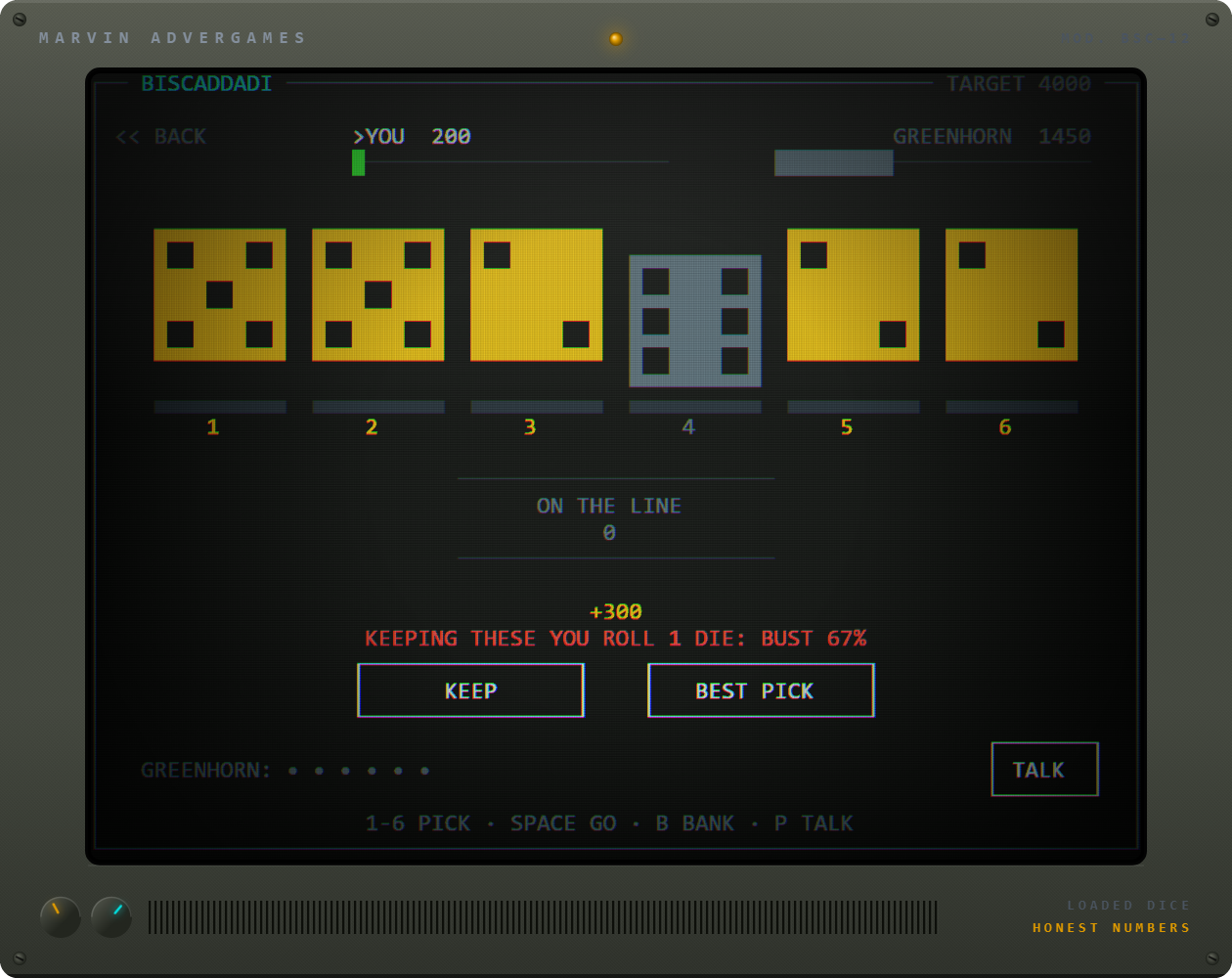
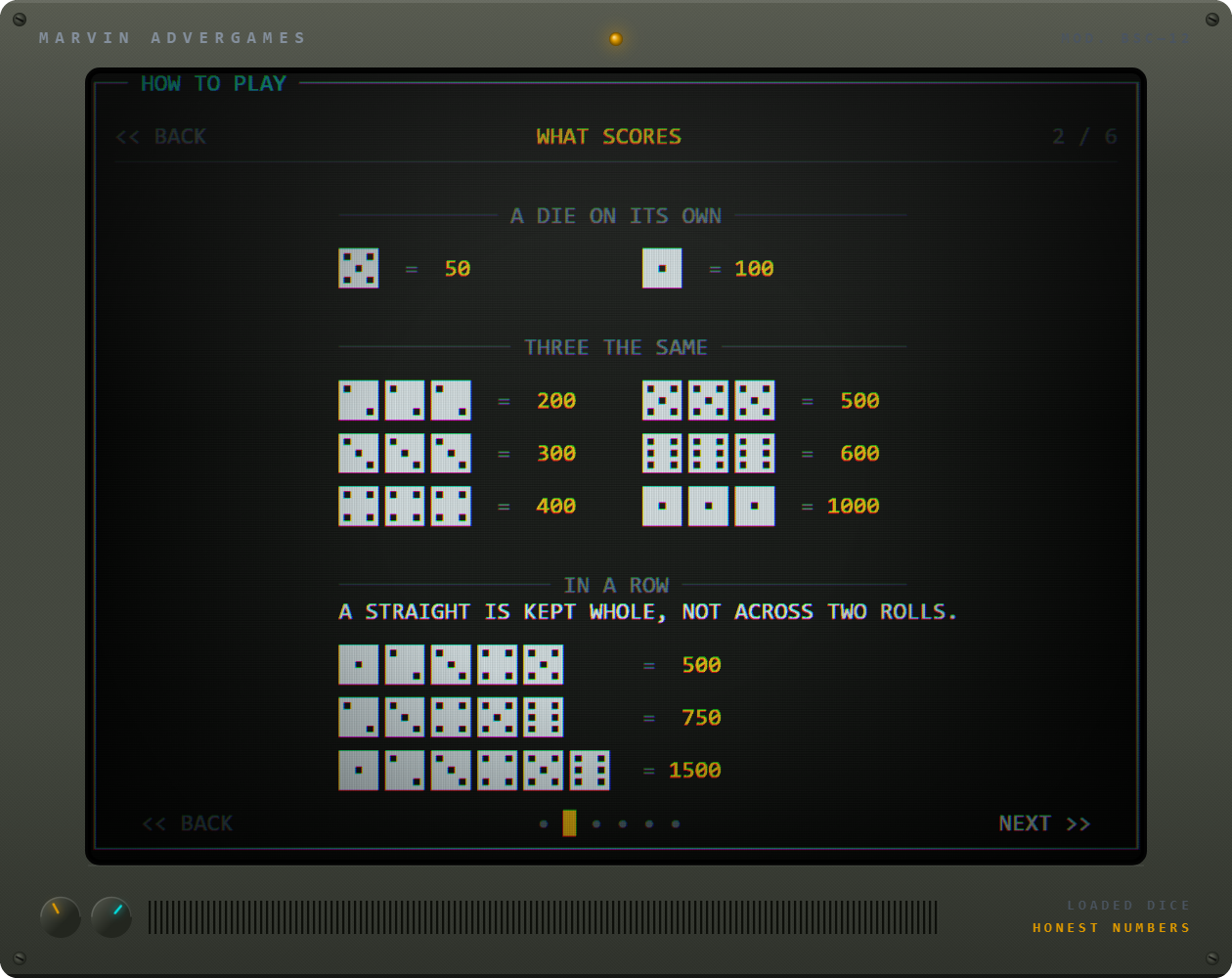
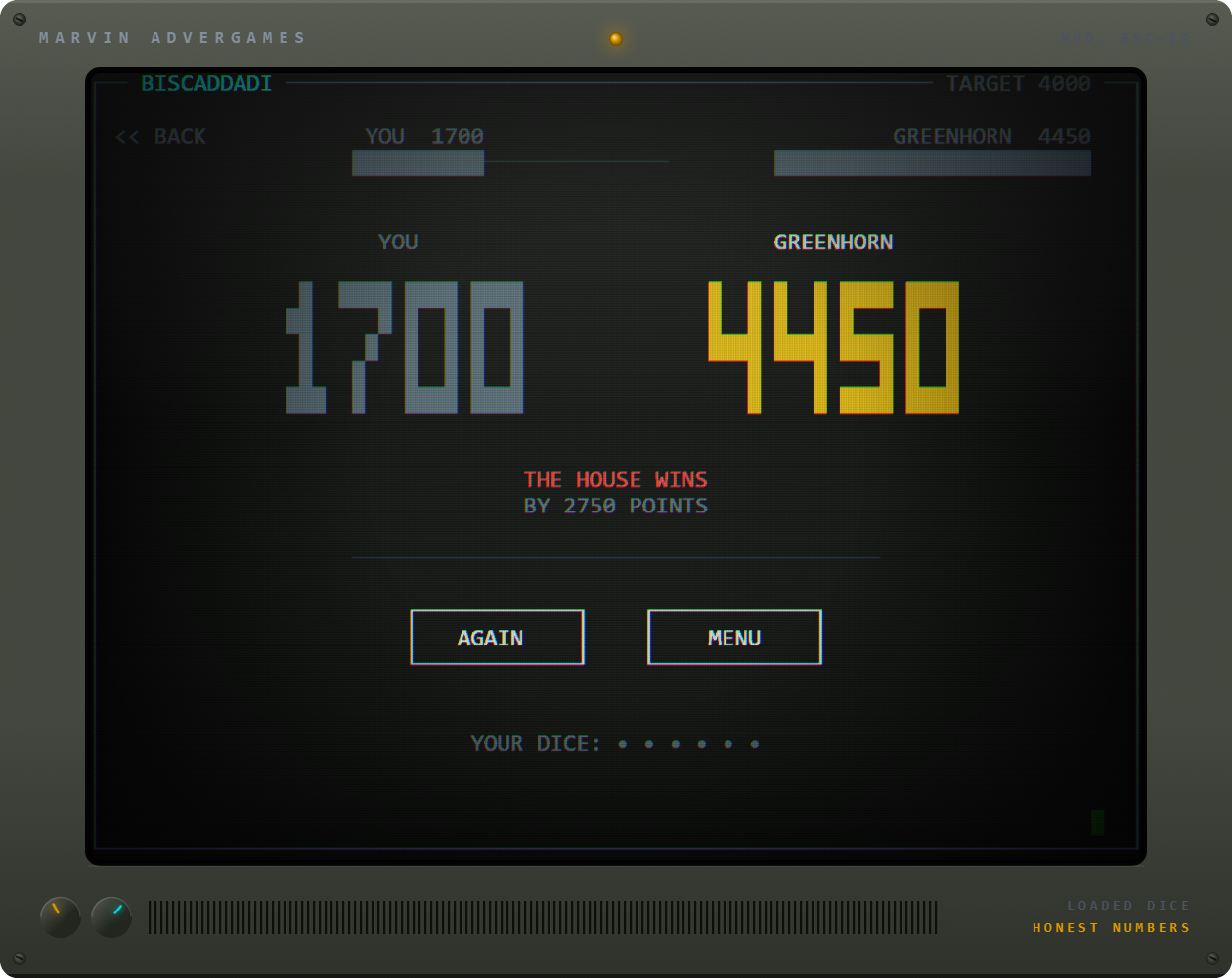
Roll six dice. Keep what scores — ones, fives, triples, straights. Roll the rest, or bank what you have. Roll once too often and the bust takes the whole turn away. You play to 4000, and the target closes the round, not the game: whoever is still owed a turn plays it, and wins only by finishing 500 clear.
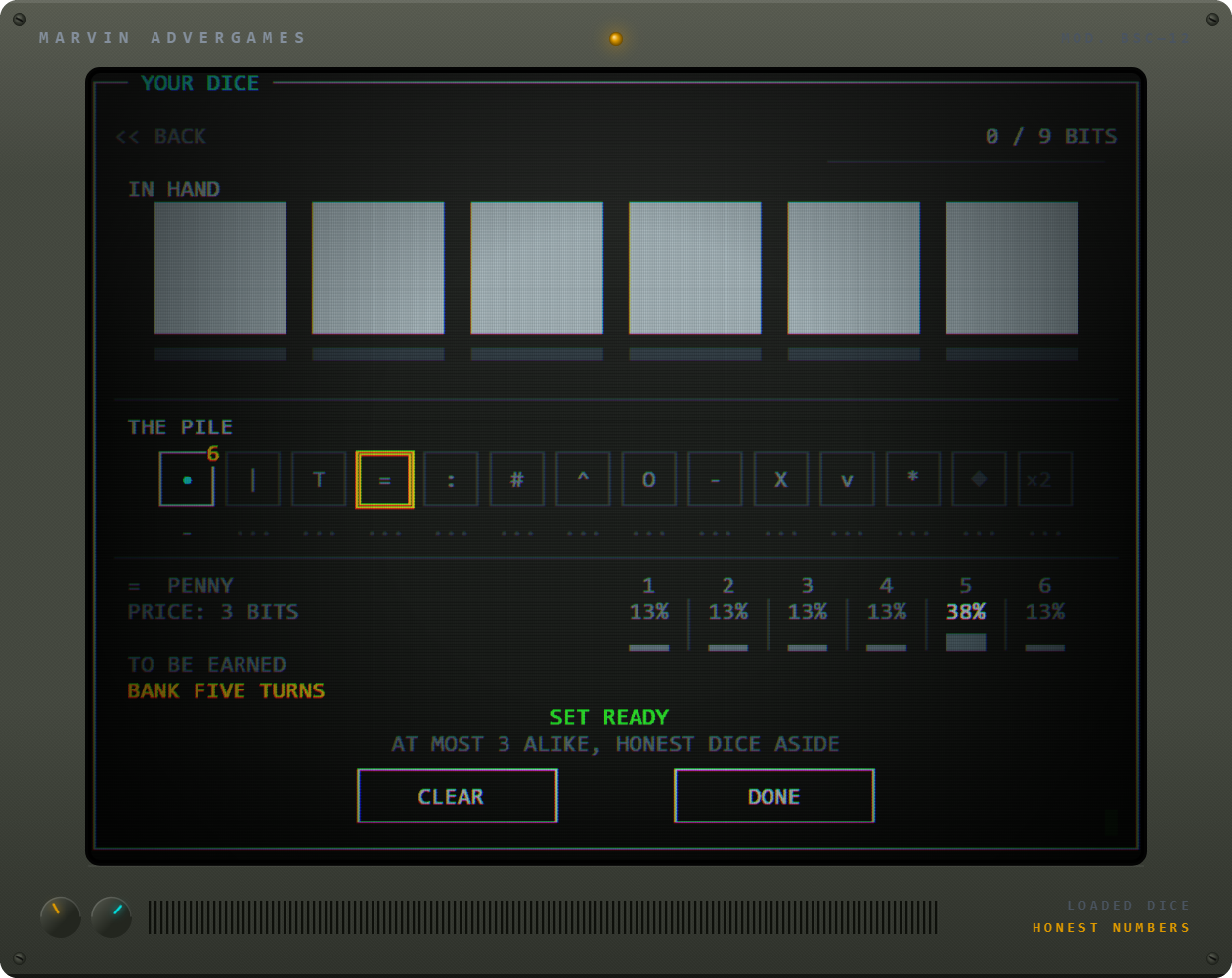
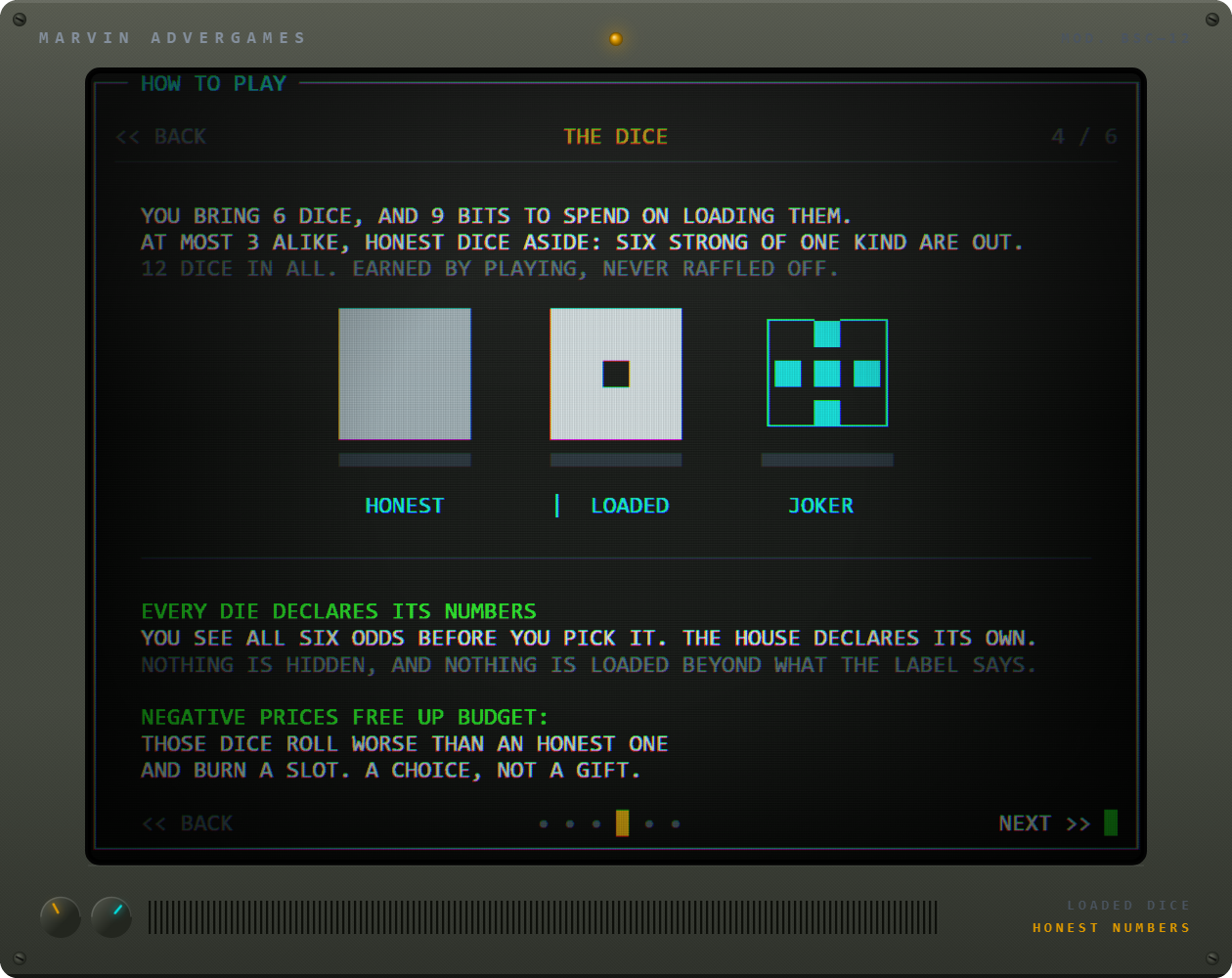
The hook is the dice. Twelve of them, each with its own trade: a drop of lead under the six, a die that dreams of being a coin, a fool that plays any face, a debt that buys you budget and charges you every roll. You bring six to the table and nine bits to load them with — strong dice cost, bad dice pay you back — and you read the exact odds of every face before you pick it. Nothing is hidden, and nothing is loaded beyond what the label says.
Play the house, which shows you its dice before you sit down, or pass the screen to a friend.
And online, one die can be put up. Whoever wins the match takes it — lose your last copy, and the die goes back to being earned. It is the only thing in the game that can destroy a die, and the screen tells you exactly what you are risking before you agree.
What you are looking at
Some of this is only visible if you go looking, which is rather the point.
- Twelve dice, every probability declared. No hidden weighting. The house declares its own before the match.
- A set builder that is a real economy. Six slots, nine bits, at most three alike (honest dice aside). Negative-cost dice roll worse than honest ones and pay you budget: every crooked die is an honest choice.
- Two people at a table, from a link. No account, no install, no app. The table service is our own code, running as a Cloudflare Worker: no third-party lobby sits between the two players.
- And at the table you talk — forty-eight lines in six moods, and the other player reads them in their language, Italian or English. A Farkle table where somebody talks back.
- Drawn in code. The dice and the type are characters on an 80-column grid; the tube — curvature, phosphor trail, scanlines — is a WebGL2 shader, with a plain Canvas 2D tube standing in where WebGL2 is missing. No sprites, no engine, no dependencies at all. (The tube is a WebGL2 port of Mattias Gustavsson's newpixie CRT, MIT.)
- At 0.4.5: 545 benches, and 123 defects planted on purpose to check that the benches notice. All caught. Every number that could be measured was: the price of each die, the three-copy cap and the 500-point margin were read off simulated matches against six honest dice, not off taste.
Thirteen turns a match, on average, on an eighty-column character terminal with a tired CRT in front of it. Free, in the browser, nothing to install.
The online table lives at marvinadvergames.com. This page is a window: the house and two-players-one-screen work right here, but the table service answers one address only, and that address is home. The game will take you there — the link is in the menu.
Built by Marvin Advergames, who make browser games for brands. This one is ours, and it is the long-form answer to what we can do.
Development log
- Loaded dice, honest numbers15 days ago
Leave a comment
Log in with itch.io to leave a comment.